Tuesday, February 18, 2014

Week 7 - Humidity sensor Group C Kyung Yoon

Humidity Sensor

There are many things required to condition indoor air quality to human comfort. Especially cold winter like this term, it is easy to experience what low humidity can do to human comfort. However, too high of humidity can also create discomfort for indoor environment. That's when the humidity sensor takes a role.

Humidity is not only effecting human comfort, but many others that could be affected like followings;
(1) Many industrial processes are humidity sensitive; product quality, yield, and cost often depend on controlling the humidity within some acceptable band.
(2) Human health, comfort, and productivity are adversely affected by extreme relative humidity.
(3) Optimal functioning of various home appliances necessitates humidity sensing and control.

(4) Modern, solid-state electronic equipment is susceptible to damage by the discharge of electrostatic energy that can accumulate if the environment is too dry.
                                                                                                                 - Kulwicki, 1991


Among many different sensors out there, there are two main sensors being used the most: ceramic and polymeric humidity sensor. Ceramic sensor is based on the absorption of water molecules through porous semi-conductor. Polymeric sensors can be divided into two categories: one using capacity of sensing principle, while the other uses resistant effects. Capacitive effect is basically sandwich the hygroscopic dielectric material with a pair of electrode forming a small capacitor. This capacitor will determine the values based on presences of moisture. Resistive effect is based on number of movable ions sensed by polymeric film. Change in humidity will change in resistance of the film.

Despite the fascinating process of sensors, they are not always accurate. For ceramic sensors, it requires integral heater to calibrate the system. The system often be contaminated by oil vapors or smoke. The cost of the sensor would go proportion with frequent of self heating process and the complexity. On the other hand, polymeric humidity senors are bulk effective sensors that it's less sensitive, slower respond time required, and hysteresis, but it has lesser chance to get contaminated like porous ceramics.

Different sensors will be used in different environment and preferences. It goes same to BIM as well. BIM model will analyze the building before it was built. It will analyze the indoor air quality to make sure it is in good shape for people to living in. However, BIM model does not consider long term effects like how oil vapors and smoke affect on humidity sensors, at least, revit doesn't. BIM can be very useful in many different way, but putting all the trust in BIM could cost owner more money than without BIM. BIM is relatively new to the industry. There are many tasks that could be done in BIM, but many many people, especially owners, expect more than what it can do. All the owners and BIM users should study and understand the process of construction and maintenance while understanding the program itself.


Sources:
http://www.engineersgarage.com/articles/humidity-sensor
Group C: Humidity Sensor


Humidity can be defined as the quantity of moisture (water) in the air. The warmer the air is, the more moisture it can hold. Relative humidity is a percentage that helps quantify the amount of moisture in the air. It is the ratio of the moisture present in the air to the maximum amount of moisture the air can hold at that temperature. A humidity sensor would measure and report this quantity. Most humidity sensors work by using a “capacitive measurement” system [1]. These sensors use two metal plates and a non-conductive film that will collect the moisture in the air. The moisture will cause voltage changes between the two plates, which in turn will be converted into digital readings of the air relative humidity. 
   
These sensors are used in residential, office, and even industrial settings. Humidity sensors can be integrated into the HVAC system in order to constantly monitor and control indoor air moisture levels. Humidity sensors are important because humidity affects human comfort, and can even cause health concerns. Indeed low humidity can cause breathing problem or joint pain, and high humidity can cause mold and fungus growth [2]. In an industrial setting, certain processes are very sensitive to humidity, and the moisture in the air must be maintained around a certain level. Paper production or pharmaceutical processes for instance.  

Sensors definitely play a very important role in the development of intelligent buildings. Sensors help with the automation of certain processes in the building. A robots functioning with a humidity sensor could automatically regulate the amount of air blown into a room to maintain an appropriate relative humidity.

I had a basic understanding of the use of humidity sensors, although I did not know exactly how they functioned. Doing research actually made me aware of the crucial role humidity sensor play in day to day operation of a building. When think about indoor air comfort, we often focus on temperature, but relative humidity is very important. As I stated bellow, certain levels of moisture are responsible for health problems in residential homes. In a city like Philadelphia where temperature range from 10°F to 95°F annually, constantly monitoring the humidity in the air becomes even more important.


Comments on others posts:

Matt’s post: I found your post very interesting. As I stated in my own, I have taken for granted a lot of the things sensors do in a building. I would have thought pressure sensors would only be useful in medical settings when keeping a patient in isolation. I had never considered how it is used in the HVAC and plumbing system. Your pictures were also a very good idea. I helped understand the concepts and the functioning of the sensors better. Your post mentioned the use of pressure sensor to keep workers and occupant safe in high rise building. Is the technology already being used, or is it a prediction?
Yoon’s post: I liked that you found so many more example of humidity sensor. It was nice to see the different options out there. I only discussed the “Capacity” polymeric sensor. I also like that you mentioned the limitation of both system. I chose to focus on their role, as well as their possible future application. Reading the other blog posts, I felt that sensor are getting more and more precise and effective. Do you think that there are less common sensors that can perform better than the ones you mentioned? 


References:

[1] "Humidity Sensor." EngineersGarage. N.p., 2012. Web. 18 Feb. 2014.

[2] Erdemir, J.S. Metzker, and C. Wilborn. "What Is a Humidity Sensor." WiseGeek. Conjecture, 17 Jan.
      2014. Web. 18 Feb. 2014.


Week 7 - Pressure Sensor

Week 7 - Pressure Sensors Group A - Matthew Morimoto

Pressure sensors are transducers that typically measure the force exerted on a vessel by a gas or liquid expansion or contraction.  They have are in used in thousands of daily applications and can be used to indirectly used to measure gas flow, speed, water level, and altitude. And in the world of sensor technology there are multiple firms that create pressure sensors each with their unique purposes.

The most common types of pressure measurements include:

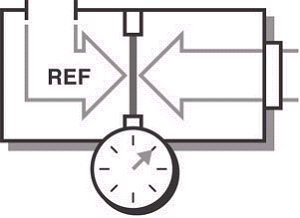
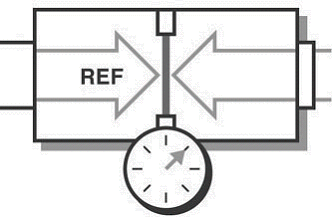
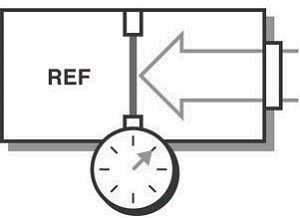
  • Absolute pressure (Above) - A sensor that measure the pressure relative to a perfect vacuum

  • Gauge pressure (Above) - Sensor that measures the atmospheric pressure
  • Vacuum pressure - Used to measure pressure below atmospheric pressure

  • Differential pressure (Above) - Measure two pressure at different ends of the sensor 
  • Sealed pressure sensors - Measure pressure relative to an preexisting pressure
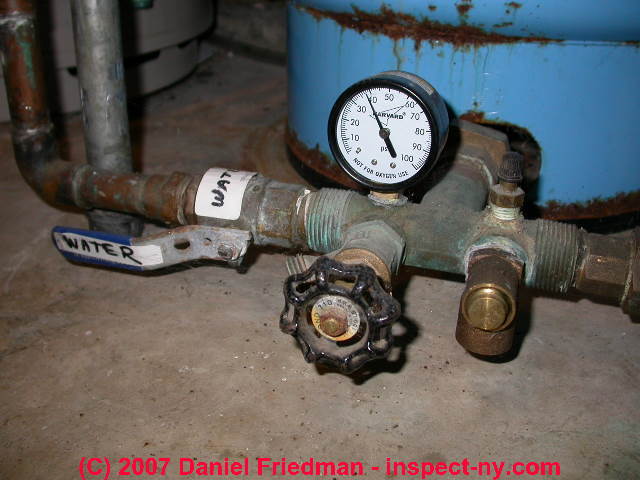
  Each have their unique uses and are used in different applications however in the intelligent building system pressure sensors are usually to measure steam and water pressures that are used in the HVAC systems.  The water pressure is vital in a building system for both most critical systems (heating, cooling) as well as the potable water and sewage that is used on a daily basis by the user.  In order to keep pressure at a constant level it is important that sensors are installed in the flow pipes as to regulate the chances of bursts, leaks, and low pressure systems.  What is great about these sensors is that with feedback systems it can utilize the boiler and chiller at their optimum levels and remember the peak hours of consumption.  By doing so not only is energy being saved but a large amount of water consumption which will save the owner money over time.   This also applies to the steam and hot water portions of the HVAC system which is used in every system. 


Another use of pressure sensors that one day might come into the fray is the use of altimeters and high altitude pressure sensors.  Over the next decade the buildings of the future will continue to get taller and taller and these sensors will help both the construction and design aspects of the building.  Eventually we will be building at altitudes will less oxygen than on the surface of the earth for this reason it will be important for construction crews to carry their altimeters in order to stay in safe areas to work and use oxygen when the atmosphere begins to thin.  Additionally the same technology that is used in weather balloons can be used to design the of skyscrapers.  The pressure sensors that are used have additional sensors such as temperature, light, humidity, and acceleration sensors.  By including these into the building it will be able to give feedback on the affects of building at high altitudes.  


While pressure sensors don't seem that interesting there are many uses for them in almost every daily function.  In the future of buildings pressure sensors will become more heavily used but probably never to the extent that they are used exclusively.  So in the meantime the technology will continue to develop in order to accommodate the needs of tomorrow.

Sources:

"Fundamentals of Pressure Sensor Technology." Sensors. N.p., n.d. Web. 18 Feb. 2014. http://www.sensorsmag.com/sensors/pressure/fundamentals-pressure-sensor-technology-846

"How To Measure Pressure with Pressure Sensors." - National Instruments. N.p., n.d. Web. 18 Feb. 2014. http://www.ni.com/white-paper/3639/en/

Reviews:

Flow Sensors by Dongyan Qi - I liked the different approach that you took to this assignment by looking at a system that didnt relate to intelligent buildings.  Its refreshing to see something new and different in the posts.  I wish that you had gone into some further depth into your subject matter but I understand how busy you are.

 Temperature Sensors by Tyler Woyshner - Im glad that you explored outside the typical fluid expansion devices that are so typical in the real world.  I forgot that infrared radiation was a way that the sensors was measuring temperature.  I wonder how good of an indicator infrared detection actually is.  Unlike most sensors the infrared detector picks on radiation that is indistinguishable to the human eye so I would really like to do some research as to how effective those systems are.


Week 7 - Temperature Sensors

There are many different types and many different uses for temperature sensors. For instance, temperature sensors can be used in food processing, HVAC control, medical devices, and in other parts or machines that require monitoring such as cars or chemical handling. By and large, temperature sensors are used to make sure that items aren’t overheating or performing at a level they weren’t designed for.

As Carolyn Mathas points out in her article, there are two main types of temperature sensors – contact sensors and noncontact sensors. Some examples of contact sensors are thermocouples and thermistors. These two are making physical contact with whatever object is in need of monitoring. The subsequent heat that is released by the object is then directly recorded by the sensors. Conversely there are noncontact sensors. These noncontact sensors measure the amount of heat that radiates from the object in question. These would be preferable in environments that aren’t exactly safe for a sensor to be installed or if the installation of a contact sensor would interfere with the function of the object that needs to be monitored.

Another part of the article that I found very interesting was the use of infrared sensors. I’d like to directly quote the Carolyn Mathas here because I don’t want to paraphrase the exact science of these sensors.
Infrared sensors are used to measure surface temperatures ranging from -70 to 1,000°C. They convert thermal energy sent from an object in a wavelength range of 0.7 to 20 um into an electrical signal that converts the signal for display in units of temperature after compensating for any ambient temperature. 

I found it absolutely incredible that infrared sensors were capable of such accurate temperature sensing. I didn’t think they’d be able to handle both extremes spectrums of heat and coldness and additionally, monitor such minute wavelengths.

            In my own personal experience, the only temperature sensor I’ve ever known to interact with is that in my car. I suppose the thermometers in my refrigerators and freezers qualify as a sort of temperature sensor, but nothing close to the magnitude of what is described in this article.

Reference:
Mathas, Carolyn. "Temperature Sensors." Digi-Key. N.p., 27 Oct. 2011. Web. 18 Feb. 2014.

Comments:

Phil - I never knew how useful pressure sensors were and I had no idea about their future potential as you described in your article. Good find on that Siemens pressure sensor, it really enhanced your article. Keep up the good work.

Signe - Great post Signe! You give a very detailed explanation of flow sensors, but what I like most about your post is the use of those images - they really helped me visualize what exactly flow sensors do. 

Week 7 - Group A - Pressure Sensors - Phil Brubaker


                This week’s blog post topic for group A is about pressure sensors.  According to Google and Wikipedia, a pressure sensor is a sensor that measures the expression of the force required to stop a fluid, often gasses or liquids, from expanding and is often in terms of force per unit area.  In the simplest terms, a pressure sensor acts as a transducer or indicator to measure the pressure of a specific area and often work as a security measure whenever the pressure within that specific area becomes greater than, or less than the anticipated pressure.  Pressure sensors are used throughout a variety of different industries and can be used to measure everything from a change in altitude of a gas or liquid to the flow or movement of the same gas or liquid.  As expected, pressure sensors that can perform multiple processes with greater accuracy will ultimately be a greater cost than those pressure sensors less capable or accurate.

                There are five main types of pressure sensors, each measuring different pieces of information.  Absolute pressure sensors can be utilized to measure certain pressures similar to atmospheric pressure, while a gauge pressure sensor can be utilized to measure a more contained pressure such as that of an inflated car tire.  A differential pressure sensor can be utilized to measure the pressure difference between two specified points within a system, while a sealed pressure sensor is utilized to compare a measured pressure to sea-level pressure, and a vacuum pressure sensor can be utilized to measure any pressure below zero pounds per square inch.  

                Pressure sensors are often incorporated into buildings in a variety of ways.  One of the most obvious uses of a pressure sensor is within a building’s HVAC system.  For example, the Siemens Differential Pressure Sensor for Air and Non-Aggressive Gases (Model #QBM66) is used to “acquire the differential pressure of air or nonaggressive gases in ventilation, air conditioning, and heating plants.  The differential pressure sensors are used to measure over- or underpressure in air ducts in relation to ambient pressure as well as to monitor filters and to control fans and acquire pressure differentials between different rooms.”  With sensor technology expanding so rapidly, the variety of uses within intelligent buildings is rising as well.  Pressure sensors will almost definitely be utilized in the buildings of the future to monitor entire building systems as well as improve the safety and well-being of those within.

Sources:

Whatley, Tiesha. "How Do Pressure Sensors Work? | EHow." EHow. Demand Media, 28 Oct. 2008. Web. 18 Feb. 2014. <http://www.ehow.com/how-does_4564501_pressure-sensors-work.html>.

“Pressure Sensors.” Siemens. Building Technologies.  2014. Web. 18 Feb. 2014. <http://www.buildingtechnologies.siemens.com/> 


Comments:

Michael Kilgallon:             Great post!  Good point about sensors being used to measure what goes on immediately outside the building and not just monitoring what is happening inside the building.  Also, your point about pressure sensors being used in non-destructive testing was a wonderful incorporation of the knowledge we learned from Dr. Bartoli in CIVE 615!

Audrey Ryan:     Great post!  Very technical and broken down so it was easy to follow and understand.  You made a great point about the infrared/non-contact sensors and resistance temperature detectors!


Monday, February 17, 2014

Flow Senors

      In order to find out what is the flow sensor, we need to have a basic understanding of the word “ flow”. It is defined as the rate (volume or area per unit time) at which a substance travels through a given cross section and is characterized at specific temperatures and pressures. I understand that this rate can appear in any place or field to identify the volume with given unit time or the time with given area. Therefore, an instrument has been provided to measure the flow called flow meter. It includes the main components, which are the sensor, transmitter and signal processor. Flow sensor measures the flow through a given area by using electromagnetic fields and acoustic waves. Nowadays, the most common tool to measure flow is the flow senor depends on its accuracy and low cost, so the flow sensors have been widely used in chemical and petroleum industries.

       I found one article discussed the mass airflow sensor. I’m interested in this topic because it tells me how the actual airflow sensor finds out the total of air entering a fuel-injected internal engine in a car. The airflow sensor can find out the amount air passing the aperture in a given time, and this airflow mass information is necessary to deliver the correct amount of fuel mass to the engine. Basically, my understanding is the airflow sensor tells the computer to adjust how much fuel need to be added into the motor and create the correct internal combustion by calculating the volume inside aperture space. Besides that, the airflow sensor not only testifies the airflow rate, but also determines the temperature of the air. This helps to increase the engine safety factors by displaying the signal to show what is ideal temperature rate.

   Most of flow sensors are small and easy to operate. The benefits for the sensor are its accuracy and low initial cost (some have a little high maintenance cost). Consequently, flow sensor has become a major component in many economic success or failure of any given process. Most importantly, accurate flow sensors ensure the safety of the process.


Source:
“Flow Sensors” Ashwini Miryala, Kyle Scarlett, Zachary Zell, Brandon Kountz (Spetember 14, 2006) 
“What is Mass Air Flow Sensor”-Slide Sharehttp://www.slideshare.net/BuyAutoParts/what-is-a-mass-air-flow-sensor

Comments:
To Signe:
I liked the pictures you provided in the blog, and I’m also interested in the CFD fluid flows. My question is how this CFD dividing the space in a BIM model and what’s the accuracy for this system if the fluid flow changes frequently.

To Carvalho:
After reading your blog, I just realized that there are a lot of movement sensors around us, which bring us convenience and safety. I believe that the movement sensor give the benefits to those handicapped and elderly people.


Flow Sensors - Blog Post 6

Flow Sensors are a critical part of any HVAC sensor system.  Flow sensors are used in ductwork to determine the flow rate of the air in the duct.  This can be done in two different ways either by differential pressure detection systems or thermal flow measurements.  The differential pressure detection either measures a pressure difference or a force.  Some common examples of these are pressure tubes or rotary measurement devices.  The rotary devices relies on blades being pushed by the flow and then calculating the flow rate from the speed at which the blades are rotating.  The thermal flow detection systems rely on the thermal properties of a material or the medium, which is flowing.  The idea behind the material based thermal flow sensors is it measures the cooling of a heated element and relates this cooling to the flow at which a fluid (air included) is moving to provide this cooling.  This relationship is non-linear and as the fluid is moving faster there is a greater cooling of the heated element.  The other form of thermal flow sensors uses an element to heat the passing fluid and measures the temperature of the fluid downstream from the heated element.  The difference between the initial temperature and temperature downstream of the element can be related to the rate at which the fluid is moving.  If the fluid is moving slowly it has more time in contact with the element and therefore is heated more and results in a higher temperature, where vice versa if it is moving rapidly the fluid is not heated as much and is cooler.
            Now how these various sensors work and their properties are good to know, but what are the applications of these sensors?  One application is in continuous monitoring of HVAC equipment.  Flow sensors can be placed down stream of large fans to measure if the fan is meeting its designed pressures.  If the flow sensor detects that the flow is dropping off it may mean that the fan element is going bad or experiencing wear.  This is important to the maintenance crew of a building as the efficiency of an HVAC system can experience a 20-30% decline with age due to failing parts.  If the crew can detect these failures and repair them money and time can be saved.  As sensors become more available and cheaper it will pave the way for more intelligent buildings and monitoring of its systems.

References:

·      B W Van Oudheusden, Silicon Thermal Flow Sensors,  Sensors and Actuators, p. 5-26, 1992
·      M. Ahauer H. Glosch F. Hedrich N. Hey H. Sandmaier W. Lang, Thermal Flow Sensors for Liquids and Gases Based on Combinations  of Two Principles, Sensors and Actuators, p. 7-13, 1999
·      Fu Xiao, Shengwei Wang, Progress and Methodologies of Lifecycle Commissioning of HVAC systems to enhance buildings sustainability, Renewable and Sustainable Energy Reviews, p. 1144-1149, 2009

Comments on other Blogs:


Very nice post lots of good information!  I honestly wouldn't have put flow sensors together with the measurement of electricity.  I think it is amazing how we can simulate flow around buildings in an urban setting.  Anyone who has walked by Ucross on a cold windy day sure wishes they had done this modeling for the building and figured out a solution.  Thanks for the post!


That is amazing only $10! And only the size of a quarter!  It goes to show just how far technology has come in a few decades.  Moisture is one of the most damaging things to the built environment as we have learned from other classes and controlling it including the humidity is so important.  Really cool post!


Nice post Ian!  I had to laugh at your splashed comment.  There are a lot of applications out there for motion sensors.  I really didn't start seeing the motion light sensors until I cam to philly.  I assume this is when the became affordable to put in as light switches.  I have heard a few people complain about the grocery store ones though because if they have one of those speed radar monitors in their car it goes crazy when you pass one of these sensors.  Good post!